|
Arrows extend from Harappa to likely source areas for raw materials such as agate, lapis lazuli, steatite, marine shell and copper. These raw materials were transformed into ornaments and tools at Harappa for local trade.
The Ravi Phase denotes a newly discovered early phase of Indus culture (c. 3300-2800 BC)
|
Map of Harappa archaeological site |
|
|
The excavation map is defined by the Harappa Archaeological Research Project, and shows the extent of occupation phases during different chronological phases. The major excavation areas featured in this presentation are Trenches 38, 39 and 42 on Mound AB, Trench 37, 41 and 43 on Mound F and Trenches 10 and 11 on Mound E.
|
|
Trench 39 South |
|
|
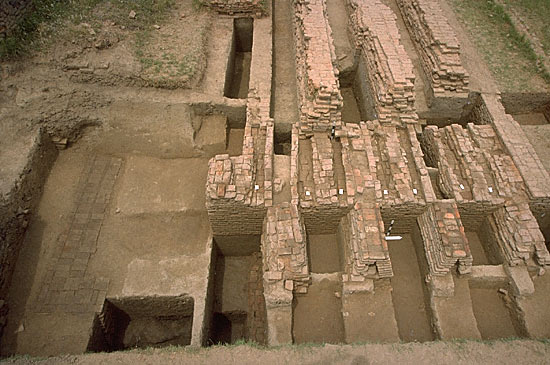
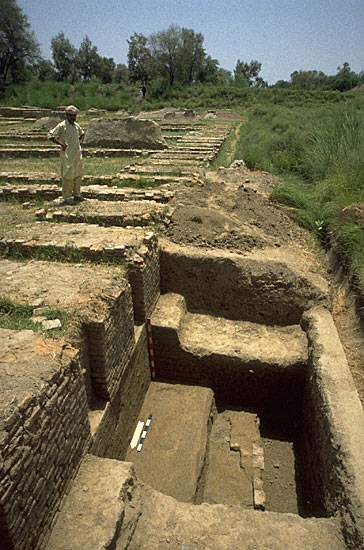
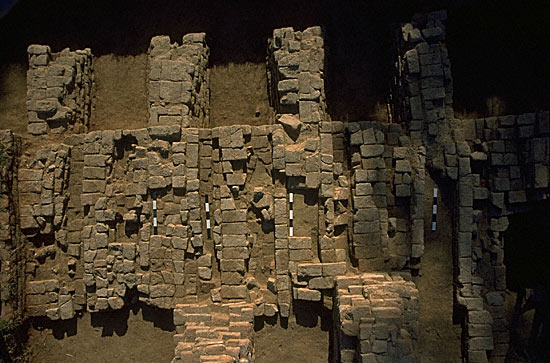
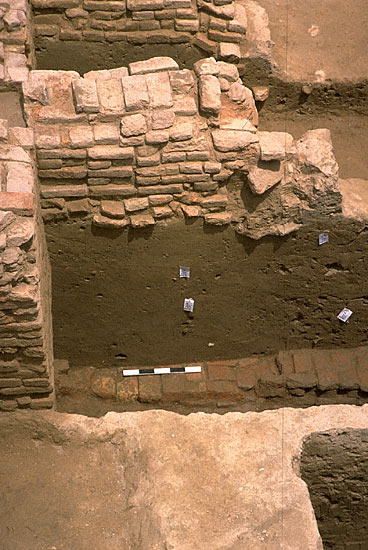
Excavations in Trench 39 South on Mound AB in 1996 revealed an extensive deposit of the Kot Diji phase occupation dating to between 2800 and 2600 BC. A geometric button seal (128) was found in the upper part of this rectangular Trench 39 South. White tags mark major features, such as hearths and floor levels. Above the highest white tag is a thick mud brick wall built during the later Harappa Phase that protected these important deposits from erosion.
|
|
Excavation team |
|
|
J. Mark Kenoyer (top center, arm outstretched) and excavation team gather at the edge of Trench 39 South at the end of the excavation season. Over the past twelve years many of the local workmen from Harappa and surrounding villages have become extremely skilled excavators and are an integral part of the Harappa Archaeological Research Project (HARP).
|
|
Trench 39S |
|
|
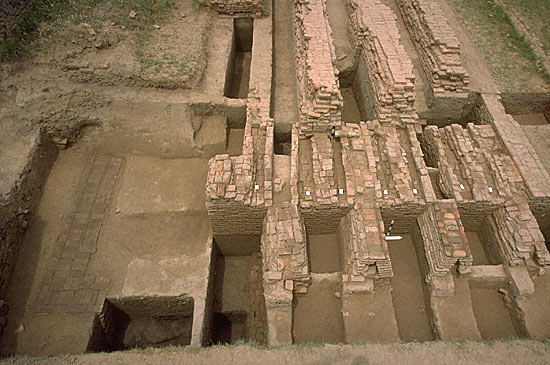
Looking up from the bottom of Trench 39S one can see habitation levels spanning over 500 years from approximately 3300 BC at the bottom to 2800 BC at the top. The white arrow pointing north is lying at the edge of a large storage pit dug into natural soil by the earliest settlers of Harappa, around 3300 BC.
|
|
Trench 39 North Excavations |
|
|
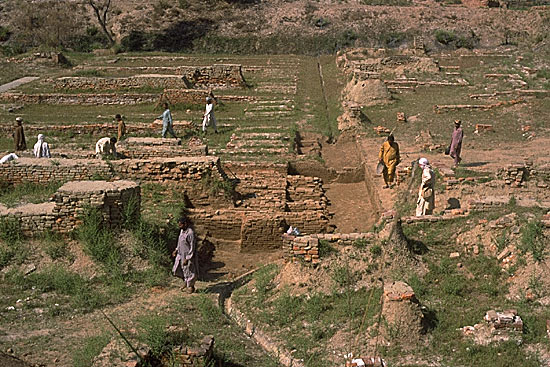
Excavations on Mound AB in 1998 began with the clearance of surface debris to expose the many habitation levels, beginning with natural soil in the lower foreground. This view shows almost 1700 years of superimposed occupation levels beginning around 3300 BC (Ravi Phase) and continuing to approximately 1600 BC (Late Harappan) at the top of the mound.
|
|
1998 Harappa Excavation Crew |
|
|
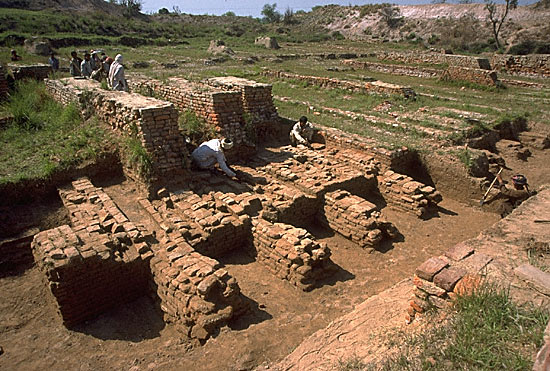
The 1998 excavation crew of the Harappa Archaeological Research Project. Seated at the front left are Mohammad Afzal Khan, representative of the Department of Archaeology, Government of Pakistan, Dr. Jonathan Mark Kenoyer and Dr. Richard H. Meadow. The group is standing at the edge of Trench 39 North with the remains of an early pottery kiln of the Ravi Phase, (circa 3300 BC) in the foreground.
|
|
Ravi Phase Pit |
|
|
During the Ravi Phase (circa 3300-2800 BC) the earliest inhabitants lived in huts made of wooden posts probably covered with reeds and clay. They stored grain and other foodstuffs in small bell shaped pits that were plastered with fine clay. The white stain in the smaller pit is a post mold and the larger pit is the bottom of a storage area.
|
|
Ravi Phase Floor |
|
|
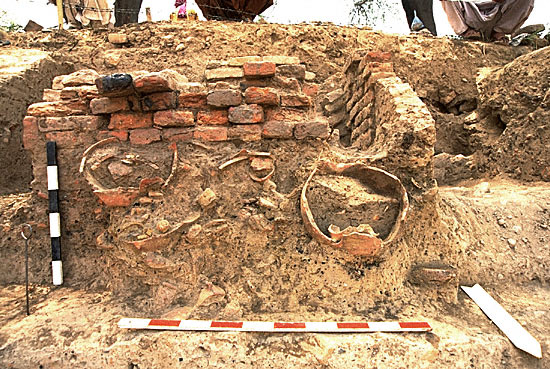
Excavations in Trench 39 South 1996 uncovered the floor of a house dating to the Ravi Phase (circa 3100 BC). Many complete vessels were found sitting on the floor along with broken necklaces, bone and stone tools, spindle whorls and bangles made of marine shell as well as of terra cotta. It is not clear why the house was abandoned with so many valuable objects scattered around.
|
|
Ravi Phase Pottery Fragments |
|
|
All pottery from the first part of the Ravi Phase was hand built. Most of the forms were finely made shallow bowls, deep bowls, narrow-mouthed carinated vessels, or thick walled cooking pots.
|
|
Hand-built Pot |
|
|
Dating to c. 3100 BC, this hand-built pot with polychrome decoration is one of the earliest examples of intersecting circle motif in the Indus valley region. This motif along with others, such as the fish scale and pipal leaf designs, continue to be employed into the later Kot Diji and Harappa Phases.
|
|
Ravi Phase Motifs |
|
|
Whereas many other motifs of the Ravi Phase (Period 1) disappear in the later Kot Diji Phase (Period 2), the intersecting circle and fish scale motifs continued to be used, but they came to be executed in black paint on a red slip. In this image the lower sherds belong to the Kot Diji Phase (2800-2600 BC) and the upper ones belong to the later Harappa Phase (after 2600 BC).
|
|
Master Potter |
|
|
Mohammad Nawaz, master potter from Harappa, demonstrates how fish scale and intersecting circle motifs may have been painted onto Harappan pottery. Here he is demonstrating at the Elvehjem Museum of Art in Madison, Wisconsin, USA during the major exhibition titled “Great Cities, Small Treasures: the Ancient World of the Indus Valley”.
|
|
Ravi Phase Pot |
|
|
This Ravi Phase hand-built pot with polychrome design was found next to the one with intersecting circles illustrated earlier (101). The net and bird motifs are found at other sites to the northwest in Bannu district, but they do not continue n into the later Kot Diji and Harappa Phases.
|
|
105. Ravi Phase Cooking Pot |
|
|
Cooking pots during the Ravi Phase were made in large globular shapes that had a low center of gravity to keep them from tipping over when filled with food. In order to protect the fine clay from cracking due to the heat of the fire, the exterior was covered with a slurry of coarse sandy clay mixed with calcium carbonate nodules and some pebbles.
|
|






comment closed