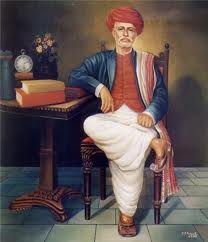
Satyashodak Movement developed by Phule in the Bombay Presidency in the late XIXth century, which was not a caste movement since it intended to represent the ‘bahujan samaj’, the majority of the people, the masses. Jotirao Phule (1827-1890) was a Mali (market gardener), a cultivating caste in close contact with towns where its members sold their products. In one of these towns, Poona, Phule could attend a school of the Scottish Mission. What he learnt about the Blacks in the United States suggested to him a comparison with the lower castes – hence his book, Slavery (1873) that he dedicated ‘to the good people of the United States as a taken of admiration for their sublime disinterested and self sacrificing devotion in the cause of Negro Slavery; and with an earnest desire, that my country men may take their noble example as their guide in the emancipation of their sudra Brethren from the trammels of Brahmin thralldom.
The writings of Thomas Paine exerted a special influence on Phule who discovered the individualist values of liberty and equality in The Age of Reason and Human Rights. This source of inspiration developed in conjunction with that of Christianity. For Phule, Jesus-Christ epitomizes equality and fraternity. He also regards him as the spokesman for the poor people. However, Phule did not convert to Christianity and even translated the Christian idiom into a new discourse focused on King Bali, the subterranean god who reigns in the underground world according to Hindu mythology.
Through the vernacularisation of Christian values and symbols, Phule endowed them with a new, positive identity to his people. He even gave them a new history on the basis of some of the findings of Orientalism. In 1792, William Jones had deduced from the discovery of the Indo-european linguistic family the notion of a common, original race whose branches had migrated towards Europe and India. This theory was developed during the nineteenth century by many German philologists such as Albrecht Weber, R. Roth, A. Kuhn and J. Möhl (whose books were published in the 1840s-1850s). In their writings appear the notions of
‘Sanskritic race’ or ‘Vedic people’. These speculations reached India from the late 1850s onwards through Max Müller, who tended to be some what more cautious, and Muir who published in 1860 a study on ‘The Trans-Himalayan Origin of the Hindus, and their affinity with the western branches of the Aryan race.
The first Hindu nationalist ideologues of the late 19th century and early 20th century _ from Dayananda to Tilak _ borrowed heavily from the European orientalists. Among other themes, the one they used assiduously related to the common racial origin of the European and Indian people and its corollary, the southward migration which they interpreted to prove that the Hindus were the first race and that they once dominated the whole world. This myth helped the first Hindu revivalists to regain certain self-esteem by claiming that their ancestors were the first inhabitants of the world.
Phule used the Aryan theory: the fact that upper castes leaders traced their origin from Aryan conquerors could be used to argue that they descended from foreigners and that their culture, including the caste system was alien to India’s original people. Phule, therefore, portrayed the Aryans as invaders who had settled in India at a rather late period to subjugate the first inhabitants of India and destroyed their civilisation. For him, the low castes were the descendents of these people. In this reinterpretation of the past, the invaders are identified as Brahmins whereas the indigenous groups are described as descending from the original ruling class, the Kshatriyas. In Phule’s ideology, this category does not refer to the second varna but includes all original Indians, from peasant castes to Untouchables. For him, they formed a people, united by the bond of a common origin and of a warrior ethos.
The Kshatriyas in India (the land of Baliraja) that is the original masters of the land here where known as Astiks, Pishachas, Rakshasas, Ahirs, Kakatas, Bhut, Kolis, Mangs, Mahars etc. They were extremely adept in fighting without the aid of arms (weapons) and were famed as brave and valiant warriors. They were of an epicurean (joyful) temperament and were given to the enjoyment of the goods things of life. The kingdoms of most of these rulers (chiefs) were in a prosperous condition, and it would be no exaggeration to say that the land of King Bali was literally flowing with milk and honey.
This description does not only present the original rulers of India as brave warriors but also emphasizes their sense of manliness and honor while fighting (they did not use weapons) and their good nature. Such a narrative prepared the ground for the stereotype of the ‘good salvage’ that will be applied to the Indian aborigines. The king of these original Kshatriyas, Bali, is described by Phule as reigning over a rich country and this prosperity was the very reason for the Aryan invasions.
The extreme fertility of the soil of India, its rich productions, the proverbial wealth of the people, and the other innumerable gifts which this favorable land enjoys, and which have more recently tempted the cupidity of the Western nations, attracted the Aryans [...] The original inhabitants with whom these earth-born gods, the Brahmans, fought, were not inappropriately termed Rakshasas, that is the protectors of the land [...] The cruelties which the European settlers practised on the American Indians on their first settlement in the new world had certainly their parallel in India in the advent of the Aryans and their subjugation of the aborigines [...] They originally settled on the banks of the Ganges whence they spread gradually over the whole of India. In order, however, to keep a better hold on the people they devised that weird system of mythology, the ordination of caste, and the code of crude and inhuman laws to which we can find no parallel among the other nations
Phule’s endeavor had a pioneering dimension since he was probably the first low caste leader who avoided the traps of sanskritisation by endowing the low caste with an alternative value system. For the first t time, the low castes were presented as ethnic groups which had inherited the legacy of an antiquarian golden age and whose culture was therefore distinct from that of the wider Hindu society ; secondly, his efforts in favor of the low castes were not confined to his castemen only: he wanted to unite the Shudras and the Atishudras (dalits). As early as 1853 he opened schools for Untouchables. He projected himself as the spokesman of the non-Brahmins at large and, indeed, kept targeting the Brahmins in vehement pamphlets where he presented them as rapacious moneylenders corrupts priests eager to extort as much as they could from poor and ignorant villagers.
Phule was also the first low caste Organizer. In 1875 he was attracted by the Arya Samaj, but he kept his distance from this movement because he did not trust the upper caste reformers who pretended to fight against the social system even though they observed its rules. Phule also remained aloof from the Congress, which he regarded as a Brahmin movement. Nationalism, according to him, was an illusion created by upper caste manipulation to conceal the inner divisions of Indian society movement because he did not trust the upper caste reformers who pretended to fight against the social system even though they observed its rules. Phule also remained aloof from the Congress, which he regarded as a Brahmin movement. Nationalism, according to him, was an illusion created by upper caste manipulation to conceal the inner divisions of Indian society.
He founded the Satyashodak Samaj in 1873 in order to strengthen the sentiment of unity among the low castes. He narrated pseudo-historical episodes bearing testimony of the traditional solidarity between the Mahars and Shudras and protested against the Brahmins’ stratagems for dividing the low castes. At least in the late 19th century and early 20th century, the Satyashodak idiom embraced rich peasants as well as agricultural tenants who belonged to very different castes and in some places ‘the Sathya Shodhak message seemed to have reached even the untouchable’. A major spokesman of the non-Brahmin movement in Maharashtra in the 1910-1930, Mukundrao Patil, the son of Phule’s colleague, Krishnarao Bhalekar, was for instance a radical defender of the Untouchables even though he was a rich peasant. He advocated ‘the general Satyashodak ideology, of opposition to Sanskritisation and assertion of the « non-Aryan » unity of Maharashtrian natives’. By that time, Phule’s view of the non-brahmins as non-Aryas had made an impact on the small dalit intelligentsia. In 1909, Kisan Faguji Bansode (1870-1946), a Mahar from Nagpur, warned the upper castes in the followingterms:
The Aryans – your ancestors – conquered us and gave us unbearable harassment. At that time we were your conquest, you treated us even worse than slaves and subjected us to any torture you wanted. But now we are no longer your subjects, we have no service relationship with you, we are not your slaves or serfs.
The Satyashodak Samaj eventually attracted even Marathas such as the Jedhe family who from Poona realised ‘the futility of a purely Maratha politics’. Keshavrao Jedhe adopted ‘the long-held Satyashodak view of history: Brahmans were outsiders to the country and to the ethnic community of true « Hindus »; they desired only their own caste superiority and consolidated their power through treachery, through falsification of historical records, and by weaving a web of religious slavery which set up a social hierarchy of superiority and inferiority and divided the masses.
Maratha princes such as the Maharajah of Baroda strongly approved of Phule’s ideological commitments and donated large amounts of money to his movement. A direct descendant of Shivaji, the Maharajah of Kolhapur, Shahu, who reigned between 1894 and 1922 and who was ‘intensely proud of his Maratha lineage’, was even more supportive. He recruited Maratha Satyas Satyashodaks in his administration. In 1902 he even reserved 50% of the vacancies in the state administration for ‘the members of the backward communities’.
Shahu patronised the establishment of the Satyashodak Samaj in Kolhapur in 1911. He promoted inter-caste dining and introduced the Intercaste Marriage Act in 1918at Kolhapur. In 1920 he appointed Maratha priests to circumvent the Brahmins and soon after established the Kshatriya Vedic School to train Maratha priests. The very name of this school suggests that Shahu was still acting in the framework of sanskritisation. Indeed, he tried to secure for the Marathas the status of Kshatriyas and in fact he broke with the local Brahmins in 1900 when they refused to recognise his family’s claim to this status and accordingly refused to perform certain rituals. He wanted to ‘kshatriyase’ the Untouchables too. He used to give them symbolically swords and Maratha names. He called them ‘Suryavaunshi’, pretending that they could trace their lineage to the sun God, Surya. Shahu cannot be described as a Maratha leader also because of its efforts to federate the low castes. In the communal representation scheme that he introduced in 1920 in the Kolhapur municipality 85 castes were grouped into 20 ‘unions of castes’.
The Marathas, the Rajputs and the Kunbis formed a constituency in themselves. Yet, the main reason why the Sathyashodak Samaj could not become a common platform for all the non-Brahmins on the basis of a non-Aryan identity had much to do with the attitude Marathas. Most of them refused to mix with lower castes and stuck to the sanskritisation process of other with which Shahu has still affinities. For instance, Bhaskarrao Jadhav, in Marathe ani Tyanci Bhasha, displayed much ambivalence: on the one hand he admits ‘the prevalence of Dravidian customs and racial intermixture among Marathas, and on the other asserts, without any qualification, (that) the Marathas are definitely « Aryan Kshatriyas »’. Therefore, even those who had followed Phule’s message for some time, eventually joined hands with the Brahmins-dominated Congress, or were co-opted by it. Congress leaders such as N.V. Gadgil, who was very much aware that the nationalist movement could only acquire a mass-basis if it attracted low caste people, contacted K. Jedhe and made an alliance with him in the early 1930s. A Maratha dominated Satyashodak Samaj, which had remained aloof from the Congress, till then, decided to join the movement.
Gradually, the Maratha rose to power within the party. In spite of this ultimate failure, from Phule to Shahu, the low castes movement of Maharashtra was characterised by very distinctive features with long terms implications. For the first time, all non-Brahmin castes were invited to unite on the basis of a common ethnic background – as the original inhabitants of India – endowed with a Kshatriya ethos and to fight the Brahmin domination. Even though the Satyashodak idiom was imbued with the symbols of kshatriyahood, this movement escaped the sanskritisation process since the upper castes were not seen as role models but as invaders whose culture could be despised. A similar pattern developed in the South with the Dravidian movement.





comment closed