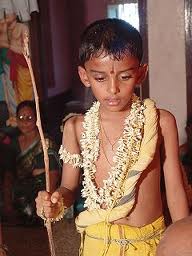
Initiation or Upanayana or Vodugu
The initiation or upanayana or vodugu described in the Grhya Sūtras (http://www.sacred-texts.com/hin/sbe29/sbe29119.htm), and the sāvitrī verse or mantra (RV 3.62.10: “We contemplate the excellent glory of the divine Savitr; may he inspire our intellect!”) was imparted to the young boy to inaugurate or start his period of Veda study.
This verse or mantra is to be composed in different meters or mantras for boys of the “twice-born” castes (Brahmin, Kshatriya and Vaishya) excluding Shudras and untouchables.
Depending on the class or caste of young initiate boy, the verse or mantra would be recited in different meters; Brahmins were to learn the verse in the gāyatrī meter, Kshatriyas in the triṣṭubh, and Vaishyas in the jagatī. This was done at the instruction of the teacher or guru after imparting of the sacred thread or Janjam, the symbol of the “second birth”.
The adjustment was not only in order to match the boy’s Varna to the meter or mantra that bore the proper power. It means Varna-encoded properties were ritually injected into the appropriate boy through the metrical medium or through mantra shakthi.
Brahmin boy initiation:
The syllabic composition of the meters or mantra (eight syllables for each line in the gāyatrī meter or mantra), so age for initiation for Brahmins is eight. So this Gayathri meter or mantra bore or inject the brahmin boy with Brahman power.
Brahman power is “tejas”, brahmavarcasa (“the splendor of the brahman power,” also connoting the “glow” obtained from knowledge of Veda), the (feminine) quality of “speech” (vac), the (masculine) sphere of Brahmin influence, the sacrifice (yajna). The Brahmins are frequently said to be “foremost” (or connected to the mouth, “mukha”) and thus taking “precedence” over all others. The hierarchical position of this class or caste can also gauged by brahman is also equated to “rta”, “cosmic-moral-order”, and with “satya” , “truth” or “reality”, etc..
It’s like installing brahman power using gāyatrī mathram, like installing some software in your computer using CD or Pen Drive.
Thus Brahmins are given innate qualities and powers (intellectual ability, a spiritual predisposition, etc), naturally incline them through the Gayathri meter.
(See Sloka from Satapatha Brahmana SB 10.3.5.10-11, http://www.sacred-texts.com/hin/sbr/sbe43/sbe4360.htm)
This brahman is the most excellent (jyestha); there is nothing more excellent than this. He who knows this, being himself the most excellent, becomes the highest (srestha) among his own people. This brahman has nothing before it and nothing after it there is no one higher among his compatriots. And his descendants will be higher still.
Like this there are hundreds of Slokas in those texts … just on Brahman …
Kshatriya Initiation:
The syllabic composition of the tristubh meter or mantra (eleven syllables for each line in the tristubh meter or mantra), so age for initiation for Kshatriya boy is eleven. So this triṣṭubh meter or mantra bore or inject kstra power in young initiate Kshatriya boy.
Ksatra power is strong in arms and legs, fitted with armor, manly, the world of politics and power (with the attendant essential powers that world requires and entails), a hero, an archer and a great charioteer, bow and arrow, virya, killing power of enemies, contest power of rivals, etc..
So tristubh meter or mantra installs ksatra power in Kshatriya initiate boy.
(See Sloka from Satapatha Brahmana, SB 2.1.2.17 “one who kill his enemies and contests with rivals”)
Again Kshatriya’s power is allowed only through Brahmin interests (see Sloka TS 2.4.13.1) When the Kshatriya was born, the gods became fearful. Being still within (the womb) they fettered him with a rope. The Kshatriya therefore is born fettered. If the Kshatriya were to be born unfettered, he would continually kill his enemies. If one (ex: an offering priest) desires regarding a Kshatriya, “May he be born unfettered; may he continually kill his enemies,” then one should offer for him the boiled offering dedicated to Indra and Brhaspati. For the Kshatriya has the nature of Indra and Brhaspati is the brahman power. By means of the brahman power he thus liberates him from the rope that fetters him.
(Sloka from Ait B 8.9; One who has a Brahmin Purohita who will “protect the kingdom” obtains the following benefits: his “kingdom does not come to early end, life does not leave him before his time, he lives to a ripe old age, he lives life to its fullest, and he does not die again”. The purohita is, in sum, the king’s safe abode.
The Ksatra is not only generated out of, and therefore secondary to, the brahman; the brahman is, we learn, the true essence of kstra: “The brahman power is called the real (sat) kstra” (AV 10.2.23).
The Brahmins do not, atleast according to the texts they wrote, submit to the of Kshatriyas; the Brahmins have a different “king” “King Soma,” the divine ruler of the sacrifice.
In the royal consecration ritual or Rajasuya, the nine-versed hymn of praise (consistently identified with the Brahmin class/caste) is withheld from the recitations, for If they were to perform the sprinkling rite (abhiseka) using the nine-versed (hymn of praise) they would give over the brahman power to the ksatra. In that they out the nine-versed (hymn of praise), they extricate the brahman from the ksatra. Therefore te Brahmins exert counter control (pratidanda) over their patrons (ie. The Kshatriyas), for they do not perform the sprinkling rite using the nine-versed (hymn of praise).
Hundreds of slokas on the friendly relationship of Kshatriya and Brahmin …. Like this …
Vaishya Initiation:
The syllabic composition of the jagati meter or mantra (twelve syllables for each line in the jagati meter or mantra), so age for initiation for Vaishya boy is twelve. So this jagati meter or mantra bore or inject vis power in young initiate Vaishya boy.
Vis power is some animal character, multiplicity, fecundity, productivity and especially subservience to the higher Brahman and Kshatriya.
So jagati meter or mantra installs vis power into Vaishya initiate boy.
Vis is divided into two, Vaishya and Shudra.
(See Sloka from Satapaha Brahmana SB 11.2.7.16 http://www.sacred-texts.com/hin/sbr/sbe44/sbe44017.htm … The second cake is the Vis (people); and, verily, whosoever knows the second cake to be the people secures for himself the people; and whatever is to be gained by the people all that he gains. And inasmuch as Agni’s cake and the low-voiced offering come first therefore the priesthood and nobility are established upon the people.
From the above Sloka …. The vis exist so that the ruling classes (Brahmin and Kshatriya) might utilize them; they are there to thoroughly and guiltlessly exploited. The Brahmins and the Kshatriyas, it is unabashedly admitted, live their privileged lives on the backs of the commoners: the two higher classes “are established upon the people”.
(See Sloka from Satapatha Brahmana SB 6.4.4.13. http://www.sacred-texts.com/hin/sbr/sbe41/sbe4140.htm … And inasmuch as, in going from here, the horse goes first, therefore the Kshatriya, going first, is followed by the three other castes; and inasmuch as, in returning from there, the he-goat goes first, therefore the Brâhmana, going first, is followed by the three other castes. And inasmuch as the ass does not go first, either in going from here, or in coming back from there, therefore the Brâhmana and Kshatriya never go behind the Vaisya and Sûdra hence they walk thus in order to avoid a confusion between good and bad. And, moreover, he thus encloses those two castes (the Vaisya and Sûdra) on both sides by the priesthood and the nobility, and makes them submissive.
See above sloka, the brahman and ksatra should “surround on both sides” the Vaishya and Shudra classes and the reason for this is so that the two higher social powers will establish and maintain their control: “And he in this way surrounds on both sides those Varnas as the with the Brahmin and the Kshatriya, and makes them stay in their place (anapakramina).
So many slokas are like this ….





comment closed